Destinations
Paris for Digital Nomads: What Nobody Tells You
Last updated · 8 min read
Paris for Digital Nomads: What Nobody Tells You
If you haven't booked the flight, comparing CDG, ORY and BVA in a single search often saves €60+ versus defaulting to Charles de Gaulle.
Paris has a reputation problem in nomad circles. People assume it's too expensive, too bureaucratic, and too focused on being Paris to bother being practical. Some of that is fair. A lot of it isn't.
The reality is that Paris works surprisingly well as a nomad base — not for every budget and not for every working style, but for people who want a European city with genuine daily quality of life and world-class infrastructure, it deserves more credit than it gets.
Here is what the city actually looks like from the inside of a monthly stay.
What it costs
Paris is expensive by Southeast Asian standards. On a Western European scale, it is not the cheapest city but it is not the most expensive either.
A realistic nomad budget for a comfortable month in Paris runs €2,200–3,200. This covers a private studio or one-bedroom in a central or inner arrondissement, daily café and restaurant spending, and leisure spending in the evenings and weekends.
Rent is the biggest line item. A furnished studio in the 3rd, 10th, 11th, or 18th arrondissements — the areas where most longer-stay nomads end up — runs €900–1,400 per month for a direct rental. On Airbnb with a monthly discount, the same quality of space is typically €1,200–1,800, plus fees.
Day-to-day spending is more manageable than the city's reputation suggests. A lunch menu (entrée, plat, dessert) at a neighbourhood bistro is €13–18. A coffee at a regular café is €1.50–2.50. A Navigo Découverte metro pass, which covers all zones for a month, is €86 and eliminates transport costs entirely. Groceries at a market or a Monoprix are reasonable if you're cooking several nights a week.
Where to base yourself
The arrondissement you choose matters more in Paris than in most cities. The 8th, 1st, and 7th are wealthy, beautiful, and expensive — fine for a weekend, but there are better choices for a longer stay. The areas where nomads tend to settle for a month are:
The 10th and 11th (République, Oberkampf, Bastille neighbourhood). These are the most practical choices. Dense with cafés, restaurants, and bars, excellent metro access, a mix of young Parisians and expats, and a wide range of housing options. The Canal Saint-Martin end of the 10th has particularly good café infrastructure.
The 3rd and 4th (Le Marais). More expensive, but extraordinary to live in daily. Extremely walkable, architecturally beautiful, and centrally located. Housing is tight and pricey, but worth considering for a shorter stay.
The 18th (Montmartre and surroundings). More residential, quieter in parts, with some of the better price-to-quality ratios for housing. The northern sections are further from the centre but served well by metro.
The 13th (Butte aux Cailles, Bibliothèque). Underrated and often cheaper. The 13th has a strong neighbourhood feel, excellent local restaurants, and is well-connected without being tourist-facing.
Coworking and working from cafés
Paris has a strong and growing coworking infrastructure. Spaces like Station F (the world's largest startup campus, technically in the 13th), Morning Coworking (multiple central locations), and Nextdoor are well-regarded options with reliable internet and professional environments.
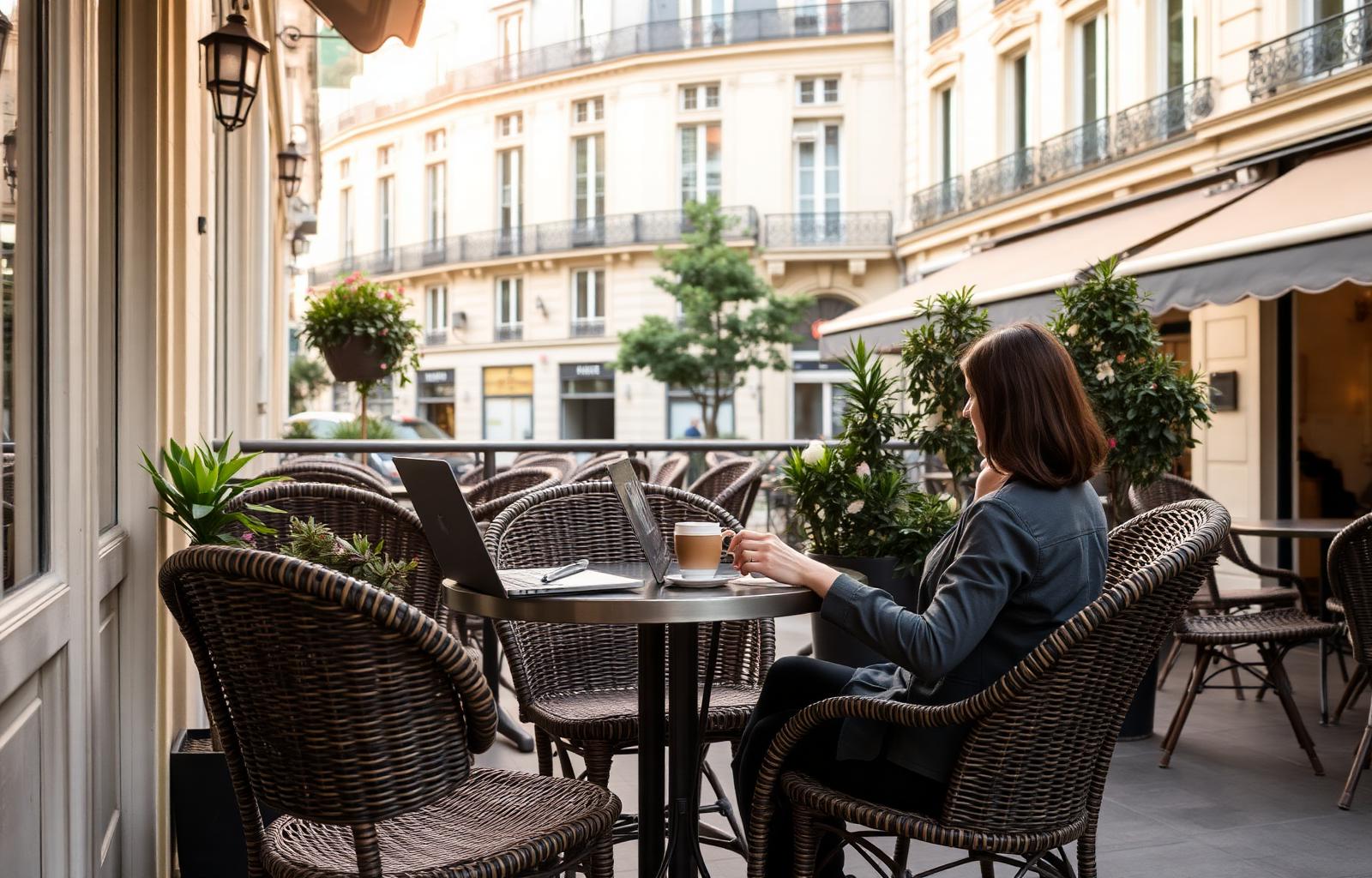
Working from cafés in Paris is culturally accepted but requires knowing the right venues. Not every Parisian café is built for laptop workers — some have minimal power outlets and consider lingering a table for three hours with a single espresso to be a social violation. The café culture in Paris is genuinely about the café experience, not productivity.
However, a growing number of cafés — particularly in the 10th, 11th, and Marais — explicitly cater to the working crowd. These are usually identifiable by their aesthetic (light wood, exposed brick, specialty coffee menus) and by the visible prevalence of laptops when you walk past. Café Oberkampf, The Hood, Fragments, and Ten Belles are among the well-known options. Wi-Fi speeds in the better cafés are typically 30–80 Mbps — adequate for most remote work.
The visa situation
Paris sits within the Schengen Area. For most non-EU passport holders, this means a 90-day stay within any 180-day period on a standard tourist entry — enough for a long month or two, not enough for an extended stay.
France introduced a digital nomad-adjacent visa (the "Talent Passport" and a freelancer visa option), but neither is as streamlined as some other European countries' nomad visa programs. For EU passport holders, no restriction applies. For non-EU citizens planning a stay beyond 90 days, the French consulate visa process applies and requires genuine advance planning — typically two to three months in advance.
For a 30–60 day stay, the Schengen allowance is sufficient for most nationalities. For longer stays, the paperwork path is more involved.
What Paris does particularly well
The food access is genuinely exceptional. This is obvious to say about Paris, but it deserves to be said practically: shopping at a neighbourhood market, eating well at lunch for under €20, and having access to world-class bakeries within two blocks is a daily quality-of-life benefit that compounds over a longer stay. People who cook find Paris particularly good value.
The cultural infrastructure is unmatched. Not in an abstract "it's a great city" way, but in a practical nomad sense: you will never run out of things to do on a slow Tuesday, a rainy Saturday, or an unexpected free afternoon. Museums, parks, river walks, neighbourhood markets, concerts — the city is built for living in rather than just visiting.
Public transport is excellent. The metro is frequent, cheap, and covers the city thoroughly. The Navigo pass makes it flat-rate and invisible as an ongoing cost.
The honest downsides
The cost is real. Paris is one of the more expensive cities on a Western European nomad circuit, and if your budget is tight, other European cities deliver better value: Lisbon, Belgrade, Budapest, and Tbilisi all offer more space and spending flexibility per euro.
The language gap matters more than in some cities. Paris is not as English-as-a-working-language as Amsterdam or Lisbon. Most service workers in tourist areas manage, but daily life — landlord emails, admin tasks, conversations with neighbours — goes more smoothly with at least basic French. Even functional French makes an enormous difference to the experience of living there.
Bureaucracy exists. Nothing about daily life is particularly complicated for a tourist stay, but anything involving official processes — opening a French bank account, dealing with French institutions — requires patience.
The conclusion
Paris works well as a nomad base for people who are willing to pay for quality of daily life and who want a European city with genuine depth. It is not the right choice for budget-first nomads, and it requires a higher monthly spend than most alternatives. On the other hand, what you get in return — the food, the culture, the physical beauty of the city, the infrastructure — is not matched by many places.
If you're going to be in Europe for a month or two and you can absorb the cost, Paris is worth it.
A Schengen-compliant insurance plan and a France eSIM are the two things to sort before you board — both are required for the visa stamp and for a stress-free first day.
Keep exploring
Pair this with the London guide for the other major European base, or our under-$1,000 cities piece for the budget alternative in Europe.
Sources & further reading
Tools & links from this story
Some links are affiliate. They cost you nothing and keep this site running.
- Kiwi.com — flights into CDG, ORY, BVA →Three Paris airports, each with very different fares.
- Airalo — France eSIM →Working data the moment you land at CDG.
- EKTA — Schengen-compliant insurance →Meets the €30k Schengen requirement.
- Klook — Louvre, Versailles & Eiffel Tower tickets →Skip-the-line for the city's busiest sights.
Written by
Meric Erdinc · Founder, 1-Minute Nomad
Meric has spent the last six years moving around Southeast Asia and beyond, with a laptop, a rotating set of Wi-Fi passwords, and an opinion on every co-working space he’s ever stepped into. Rooted in Istanbul, currently working out of Bangkok — though the next flight is usually already booked. He started 1-Minute Nomad for people like him: nomads who don’t have time to read forty Reddit threads to figure out a city. Every guide here comes from a place he’s actually lived, worked or months of on-the-ground research.
Subscribe
Get the next dispatch
One email when a new city guide drops. No spam, no daily noise.