
Destinations
London for Digital Nomads: Is It Actually Worth It?
Last updated · 8 min read
London for Digital Nomads: Is It Actually Worth It?
If you're still booking, comparing London's four main airports in a single search often saves £100+ versus defaulting to Heathrow.
London is the city that nomads love to dismiss. Too expensive. Too grey. Too much of a proper city to feel like a nomad destination. You go to Lisbon or Tbilisi; you don't "do a month" in London.
And yet people keep doing a month in London. And more often than not, they end up staying longer.
The case for London as a nomad base is not primarily a cost case. It will not win on that dimension. The case is about what the city actually gives you in return for what you spend — and whether that trade-off makes sense for where you are right now.
What it costs
Honestly: more than you want it to. A realistic budget for a month in London, assuming a private flat, daily working, and a social life, is £2,800–4,200. That's approximately $3,500–5,300.
Rent is the main driver. A furnished studio or one-bedroom in Zone 2 (the first ring outside central London, and where most longer-stay nomads realistically end up) runs £1,400–2,200 per month depending on the area, the building, and the size. In Zone 1 — central London proper — add another £300–500 on top. Serviced apartments and Airbnb monthly options in London carry a significant premium because the rental market is so tight.
Food is expensive by European standards but not absurdly so if you avoid the tourist trap restaurants. A lunch at a good casual spot is £10–18. Coffee is £3.50–5. A Tesco or Sainsbury's meal deal (lunch for under £4) remains one of the great value options in the city. If you're cooking regularly, the supermarkets are well-stocked and not dramatically more expensive than elsewhere in Europe.
Transport within central London is manageable on an Oyster or contactless card. Zone 1–2 monthly cap is around £180, which is steep compared to Paris's €86 Navigo but covers a genuinely extensive network.
Where to base yourself
The neighbourhoods that make most sense for nomads differ from those that appear in tourist guides.
East London (Shoreditch, Hackney, Bethnal Green, Dalston) is where the majority of London's remote working and startup infrastructure is concentrated. Coworking spaces are dense here, the café culture is strong, the food options are excellent and varied, and housing is cheaper relative to central or West London. If you're working in tech or creative industries, East London has a gravitational pull that is hard to justify resisting.
South London (Peckham, Brixton, Clapham) has had a decade-long moment that shows no sign of ending. These areas offer better value for housing than equivalent areas north of the river, a strong food and nightlife scene, and good transport links into the centre.
North London (Islington, Stoke Newington, Kentish Town) suits people who want quieter residential streets with good independent café and restaurant access. Less coworking infrastructure than East London but generally more pleasant for daily living.
The visa situation
Non-EU passport holders get six months on arrival in the UK on a standard visitor entry. This is, by European standards, remarkably generous — enough for a proper long stay without any advance visa application. Many nomads treat London as their European base partly because of this.
EU citizens technically require a visa since Brexit, but the UK's Electronic Travel Authorisation (ETA) system, introduced in 2024, covers most European nationalities for short stays through an inexpensive pre-registration process rather than a full visa application.
There is no specific digital nomad visa in the UK. The six-month visitor allowance is the practical option for most nomads, and for most purposes it's sufficient.
Coworking
London has more coworking space per square kilometre in its inner areas than almost any other city in the world. The range runs from WeWork and IWG (international chains with presence everywhere) to excellent independent spots with strong community infrastructure.
In East London: Second Home (a design-forward favourite in Spitalfields), Huckletree, and dozens of smaller spots in Shoreditch and Hackney. In the centre: Uncommon and TOG (The Office Group) locations throughout Zone 1. Most major coworking spaces offer day passes, typically £20–35.
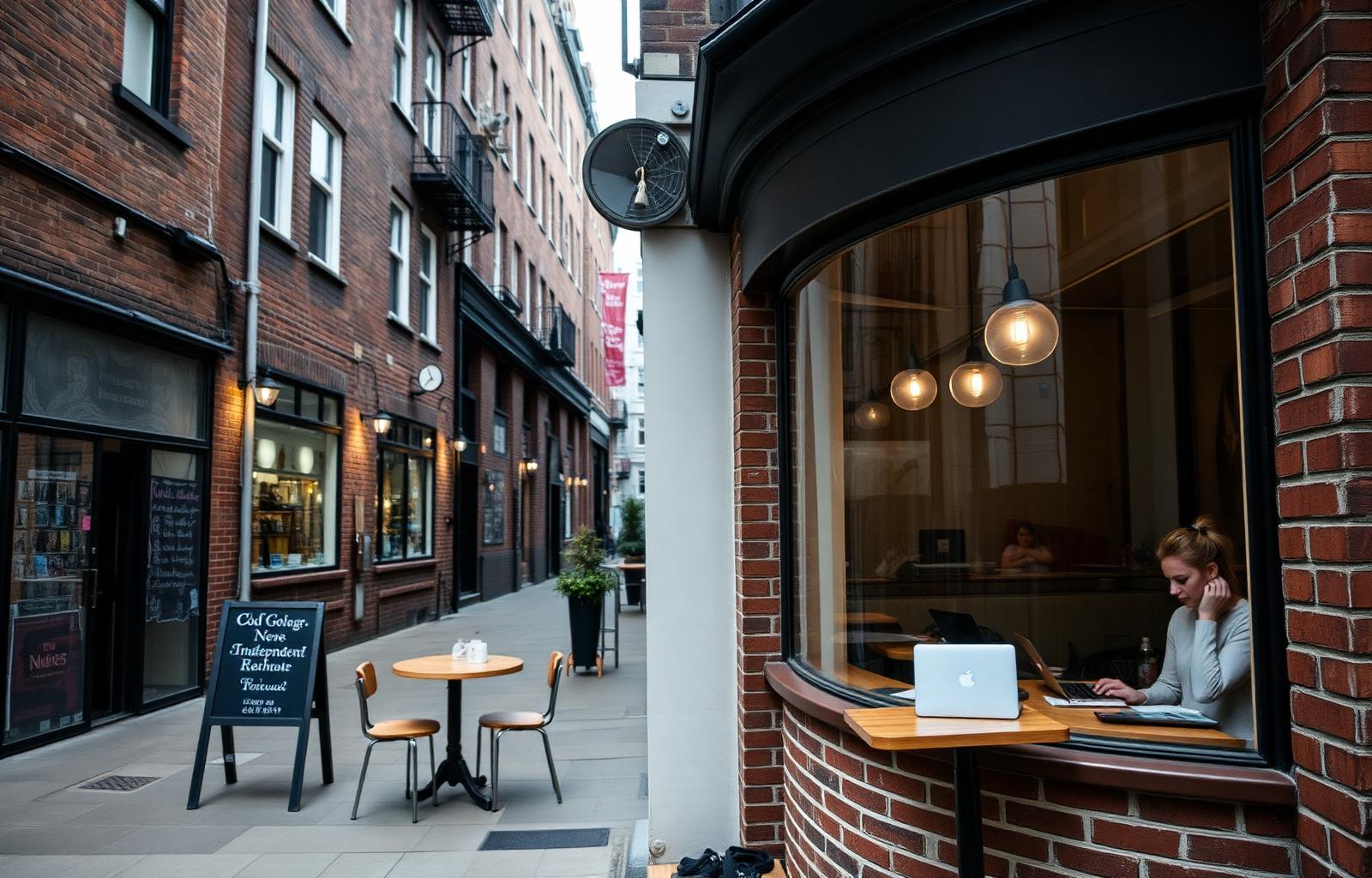
For café working, the quality of London's coffee scene — built around independent third-wave cafés, particularly in East London — is very high. Most of the better cafés are laptop-friendly, at least during off-peak hours. Speeds in the better ones run 50–100 Mbps.
What London actually offers
The English-language advantage is obvious but worth stating: every admin task, every landlord conversation, every professional interaction happens in your language. After months in cities where daily life requires navigating a second language, this is a genuine relief and a practical productivity boost.
The professional network is unmatched in Europe. If your work involves client calls, pitches, or industry events, London has a density of professional activity that other European cities don't approach. People book a month in London specifically to have a concentrated period of meetings and connections that their normal nomad circuit doesn't facilitate.
The cultural infrastructure is extraordinary. The museums are largely free. The live music scene is one of the best in the world. The food scene has genuinely outgrown its historical reputation and is now legitimately excellent across all price points and every cuisine.
The diversity of the city is a practical benefit as well as a general one. London is one of the most international cities on Earth, which means that finding community, ingredients for any cuisine, or a barber who speaks your language is not a problem.
The honest trade-off
London asks you to spend more for everything. The question is whether what you get in return justifies it.
For people who are early in their nomad journey, London rarely makes sense as the first choice. The budget required is high, and cities with better cost-to-quality ratios exist.
For people who have been nomadic for a while, who have specific professional reasons to be in London, who are from English-speaking countries and want the psychological ease of a home-language environment, or who simply want to spend a month in one of the world's genuinely great cities — the premium makes sense. You are not paying London prices for a mediocre experience. You are paying London prices for London.
That's either worth it to you or it isn't, and both answers are legitimate.
A UK eSIM ready on arrival saves you the airport SIM queue, and long-stay insurance is worth setting up given the UK's generous six-month visitor allowance.
Keep exploring
If London is on the shortlist, the Paris guide is the natural European comparison, and the Singapore piece covers the other premium English-language nomad base.
Sources & further reading
Tools & links from this story
Some links are affiliate. They cost you nothing and keep this site running.
- Kiwi.com — flights into LHR, LGW, STN, LTN →Four airports — comparing them matters.
- Airalo — UK eSIM →Online from the moment you land at Heathrow.
- EKTA — long-stay insurance →Useful given UK's six-month visitor allowance.
- Klook — Tower of London, museums & day trips →Skip the queue for the busiest London experiences.
Written by
Meric Erdinc · Founder, 1-Minute Nomad
Meric has spent the last six years moving around Southeast Asia and beyond, with a laptop, a rotating set of Wi-Fi passwords, and an opinion on every co-working space he’s ever stepped into. Rooted in Istanbul, currently working out of Bangkok — though the next flight is usually already booked. He started 1-Minute Nomad for people like him: nomads who don’t have time to read forty Reddit threads to figure out a city. Every guide here comes from a place he’s actually lived, worked or months of on-the-ground research.
Subscribe
Get the next dispatch
One email when a new city guide drops. No spam, no daily noise.