Roam Therapy
Going Underwater Changes the Way You Think About Being Above It
Last updated · 6 min read
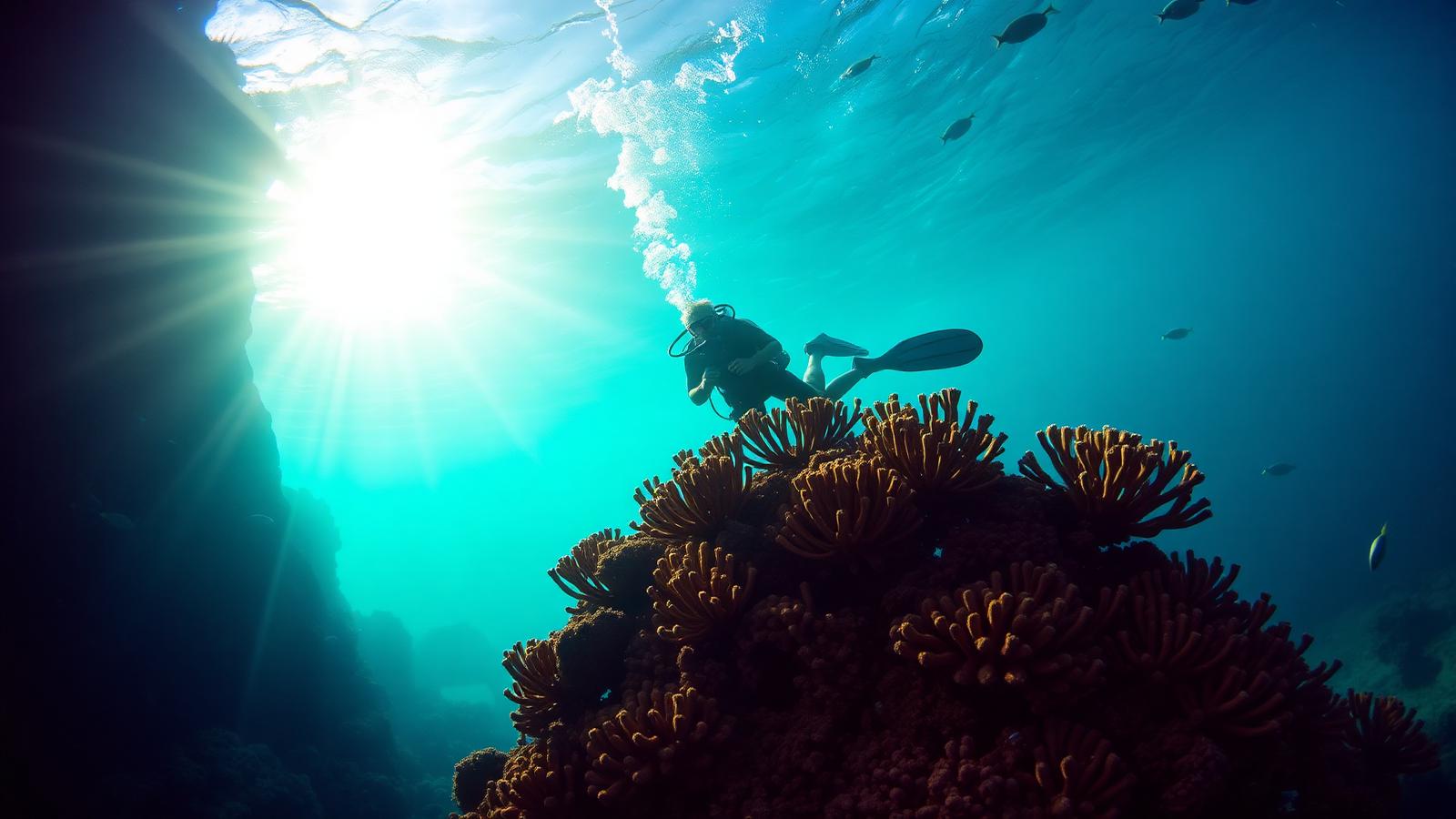
The first time you breathe underwater, nothing in your instincts believes it's happening. Every signal in your body is saying: this is wrong, this is not a place you belong. And then, a few seconds later, the breath comes. And comes again. And the world below the surface opens.
Scuba diving is one of those travel experiences that divides time into before and after. People who have dived seriously talk about it the way they talk about very few other things. Not as entertainment — as access. Access to a part of the world that most people never see.
This is what it actually gives you.
What the Underwater World Is
Coral reefs cover roughly 0.1% of the ocean floor and host an estimated 25% of all marine species. That concentration of life in such a small space produces an experience that has no terrestrial equivalent. A healthy reef at depth is visually complex in a way that takes multiple dives to start processing. Colours your brain has no reference for because they exist below the light spectrum available at the surface. Movement patterns — the way fish school, the way predators approach prey, the way a sea turtle moves through water as if floating is its natural state — that change your baseline for what elegant means.
This is before we discuss the other environments. Kelp forests in the Pacific, which feel like diving through a cathedral. Open water with nothing below you and sharks circling at a distance. Night dives where bioluminescent plankton lights up in response to your movement. Wreck diving, where history and underwater life have merged into something neither one of them is alone.
Learning to Dive: What It Actually Involves
The PADI Open Water Diver certification is the standard entry point. The course typically takes three to four days: classroom or online theory sessions, confined water (pool) training to learn the basic skills, and four open water dives that certify your ability to dive to 18 metres.
It is not difficult. The skills required — clearing water from your mask, responding to equipment issues, controlling your buoyancy — are learnable by most people in the time allocated. The physical requirements are minimal: you need to be comfortable in water and reasonably fit. Most diving centres have age minimums (typically 10 or 12 for junior certifications, 15 or 18 for adult certification) but no upper age limit.
The cost: An Open Water course typically runs between $300 and $700 depending on location. Taking the course in a destination where diving is local (Thailand, Indonesia, Egypt, Mexico) is significantly cheaper than in a cold-water European country where there's less demand. Pre-booked PADI packages in Koh Tao or Bali often beat what you'll pay walking into the shop.
Before booking, double-check that your travel policy explicitly covers recreational diving — most don't by default. EKTA's adventure-tier cover is one of the simpler ways to handle that.
The World's Best Places to Learn and Dive
Koh Tao, Thailand has trained more divers than anywhere else on earth. The dive schools are professional and competitive, the conditions are good for beginners, and the marine life is excellent. The cost is among the lowest available anywhere for a certification. If you want the whole package — learning quickly, seeing good marine life, spending your first week as a certified diver in genuinely beautiful water — Koh Tao does this better than almost anywhere. Compare flights to Bangkok or Surat Thani and ferry on from there.
The Great Barrier Reef, Australia needs no introduction as a destination, but its availability as a learning environment is underrated. Cairns-based dive operations run both introduction dives and full certification courses on the outer reef. Diving the reef itself as a certified diver is one of the bucket list items for good reason.
The Red Sea, Egypt at Hurghada and Dahab offers warm, clear water with visibility that regularly exceeds 20-30 metres. The soft coral formations and reef fish populations are outstanding. Dahab's Blue Hole is one of the most famous dive sites in the world — a deep underwater sinkhole with genuinely dramatic structure. Dahab is also one of the most affordable diving destinations in the world.
Raja Ampat, Indonesia is the gold standard for marine biodiversity. The number of fish and coral species documented there is among the highest anywhere on earth. It's not a beginner destination — getting there requires planning and the diving is for certified divers — but it represents what's possible when an ecosystem has been genuinely protected.
Cozumel, Mexico sits off the coast of the Yucatan Peninsula and has a wall dive along the Palancar Reef that is consistently rated among the best in the Western Hemisphere. The currents at Cozumel create drift diving conditions — you float along the wall with almost no effort while life passes around you.
After the Open Water Certificate: Where to Go
The Open Water certification to 18 metres covers the majority of recreational dive sites in the world. Most reefs, most wrecks in accessible depth, most marine life encounters happen within this range.
If you find that diving becomes something you want to pursue more seriously, the Advanced Open Water certification extends your depth limit to 30 metres and introduces night, navigation, and speciality diving. The Divemaster and Instructor paths exist for those who want to pursue it further.
However, the honest message for people who haven't yet started is this: the basic certification is genuinely enough to see most of what there is to see. You don't need to go deep to feel the full impact.
The Thing That Happens After
There's a standard pattern among people who take up diving. They come back from the first trip slightly quieter. Not sad — the opposite. They've seen something that recalibrates the scale of their concerns. The ocean is enormous. The life in it is extraordinary. The human problems they left behind on the surface are still there, but they feel like they belong to a smaller part of the story.
That's worth a three-day course and a certification card.
Good to know: Once certified, your PADI Open Water card is valid for life and recognised globally. Many dive operators offer refresher dives (Scuba Review) if you haven't dived for more than a year. Keep a working eSIM in dive towns — most boats are still confirmed by WhatsApp the night before.
Keep exploring
If this story landed, you'll probably enjoy why river floating slows you down, why the beach doesn't need a plan, Mallorca beyond the resorts next.
Sources & further reading
Frequently asked questions
- Where should a beginner go for their first scuba diving trip?
- Egypt's Red Sea (Dahab, Hurghada), Indonesia's Gili Islands and Mexico's Cozumel are classic beginner-friendly destinations: warm water, good visibility, mature dive infrastructure and reasonable prices for Open Water certification.
- How long does it take to get PADI Open Water certified?
- Usually 3–4 days: theory and pool sessions, then four open-water dives. You can split it — do the eLearning at home and just the dives on holiday — to save vacation time.
- Can I fly after scuba diving?
- Wait at least 18 hours after a single no-deco dive and 24 hours after multiple dives or any deco dives, per DAN guidance. Always plan your last dive day with this in mind so you don't miss a flight.
Tools & links from this story
Some links are affiliate. They cost you nothing and keep this site running.
- Klook — PADI courses, dive trips, liveaboards →Open Water packages in Koh Tao, Bali and Cozumel.
- Kiwi.com — flights to dive hubs →Bangkok, Bali, Cairns, Cancún — all comparable in one search.
- EKTA — travel insurance with diving cover →Make sure recreational diving is explicitly covered before you book.
- Airalo — eSIM for dive towns →Useful when dive shops only confirm boats by WhatsApp.
Written by
Meric Erdinc · Founder, 1-Minute Nomad
Meric has spent the last six years moving around Southeast Asia and beyond, with a laptop, a rotating set of Wi-Fi passwords, and an opinion on every co-working space he’s ever stepped into. Rooted in Istanbul, currently working out of Bangkok — though the next flight is usually already booked. He started 1-Minute Nomad for people like him: nomads who don’t have time to read forty Reddit threads to figure out a city. Every guide here comes from a place he’s actually lived, worked or months of on-the-ground research.
Subscribe
Get the next dispatch
One email when a new city guide drops. No spam, no daily noise.