Destinations
Dubai for Digital Nomads: The Tax-Free Playbook
Last updated · 8 min read
Dubai for Digital Nomads: The Tax-Free Playbook
If the trip isn't booked yet, a flexible flight search across DXB and DWC usually surfaces the better fare and the better arrival time at the same time.
Dubai is not where most nomads start. It's where some of them end up once they've done the Southeast Asia circuit a few times and start asking different questions — questions about taxes, about professional positioning, about what it feels like to live in a city that takes infrastructure seriously as a form of identity.
The case for Dubai as a nomad base is specific. It doesn't win on cost, culture depth, or authentic local experience. What it does offer — reliably, at scale — is safety, connectivity, an English-as-working-language environment, zero income tax, and a visa pathway designed explicitly for remote workers.
Whether that trade-off interests you depends on where you are in your nomad trajectory.
The visa: Dubai Virtual Working Programme
The UAE's Virtual Working Programme (also called the Remote Work Visa) is one of the more straightforward nomad visa options in the world. It grants a one-year residency for remote workers employed by non-UAE companies or running their own businesses with non-UAE income.
Requirements include: proof of employment or self-employment (a work contract or business registration), a minimum monthly income of approximately $3,500, health insurance valid in the UAE, and a clean criminal record. The application is processed through the GDRFA (General Directorate of Residency and Foreigners Affairs) in Dubai.
The visa provides legal residency, which means you can open a UAE bank account, get a UAE driving licence, and stay for a full year without border runs. It is renewable. The UAE does not levy income tax on individuals, so foreign-sourced income remains untaxed.
For shorter stays, most passport holders receive a 30-day visa on arrival with simple extension options, and most Western and East Asian passport holders are eligible for a 90-day multiple-entry tourist visa at minimal cost.
What it costs
Dubai is expensive, but it is not London-expensive or Zurich-expensive once you account for what's included. There is no income tax and no VAT on most services. Groceries at Carrefour and Lulu Hypermarket are reasonable. Eating out ranges from very cheap (Indian and Pakistani cafeterias in Deira or Karama serve full meals for $3–5) to extremely expensive (waterfront restaurants in DIFC or Downtown).
A realistic nomad month in Dubai runs $2,500–4,500. At the lower end, this means a studio in a residential area, cooking several nights a week, and using public transport and taxis rather than renting a car. At the upper end, it assumes a nicer apartment, daily eating out at mid-range restaurants, and some leisure spending.
Rent is the biggest variable. A furnished studio in Dubai Marina or Jumeirah Village Circle (JVC) runs $1,200–1,800 per month for a direct rental. In Downtown Dubai or Business Bay, expect $1,500–2,200. Short-term furnished options on platforms like Airbnb or Property Finder carry a premium for the flexibility.
Transport: the Metro covers the main nomad corridors well (Marina, Downtown, DIFC, Deira). Taxis and Careem are inexpensive by Western standards — a cross-city ride is $5–10. Having a car is convenient but not necessary if you are based in a well-connected area.
Where to base yourself
Dubai Marina and JBR is the default choice for first-time nomads, and for good reason. It's a walkable neighbourhood (rare in Dubai), has strong café and restaurant infrastructure, is close to the beach, and has multiple coworking options. It's also where a large portion of the expat and remote worker population is concentrated.
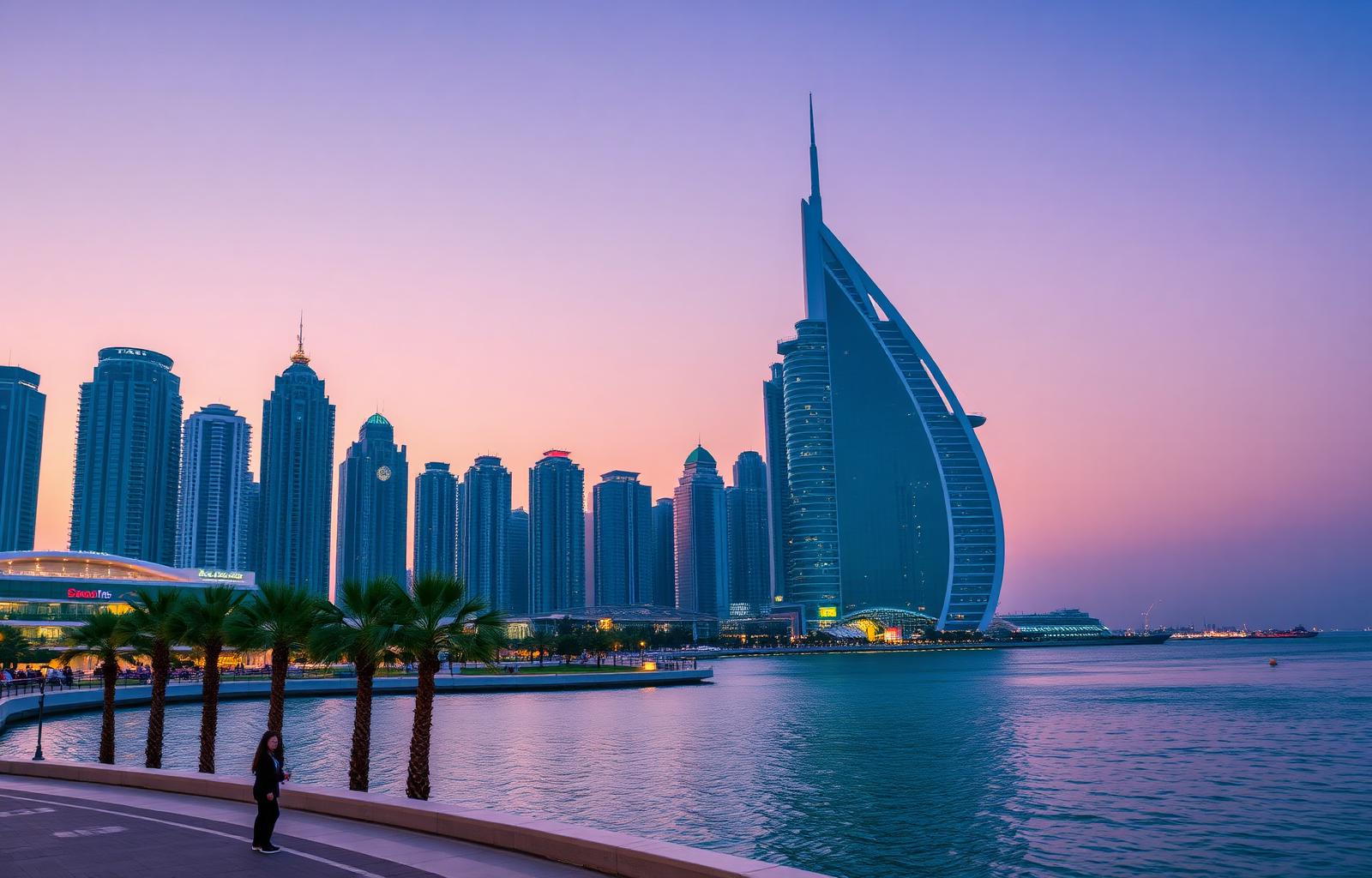
Downtown Dubai suits people who want proximity to DIFC (the financial district, where many professional meetings happen) and the iconic city skyline. It's denser and more expensive than Marina but excellent for people with a professional reason to be in that part of the city.
Jumeirah Village Circle (JVC) and Business Bay offer better value for housing and are increasingly popular with longer-stay nomads who want a proper apartment rather than a tourist-facing flat. Less atmospheric than Marina, but more practical and cheaper.
Deira and Bur Dubai (the older parts of the city) are rarely mentioned in nomad circles but worth considering for people who want authentic neighbourhood texture, local food, and significantly lower rents. The trade-off is more distance from the coworking hub areas.
Coworking and working infrastructure
Dubai has invested heavily in coworking infrastructure, particularly in DIFC and the Marina corridor. Astrolabs (one of the region's best-regarded startup coworking spaces), WeWork, Regus, and a growing number of independent spaces offer day passes and monthly memberships.
Internet speeds in Dubai are excellent — among the fastest in the world, owing to UAE's significant telecoms investment. Etisalat (now e&) and Du are the two main providers. In modern apartments and coworking spaces, expect 500 Mbps+ on fibre. VPN access: the UAE restricts VoIP calls through standard apps like WhatsApp and Skype voice calls, and some VPN services are restricted. This is worth knowing in advance if client calls are a significant part of your work. NordVPN is among the options that work in the region.
The climate trade-off
Summer (May through September) in Dubai is extreme. Temperatures regularly exceed 40°C, and humidity in June and July makes the outdoor experience genuinely unpleasant. The entire city moves indoors, which means malls, coworking spaces, and restaurants are heavily air-conditioned and effectively the entire social infrastructure.
This is not a disqualifying problem — most nomads in Dubai in summer simply live an indoor life — but it's worth knowing. The corollary is that the outdoor environment from October through April is exceptional: warm, dry, and with enough humidity for comfortable beach weather. If you're going to time a Dubai stay, November through March is the window.
What Dubai actually offers
Beyond the tax efficiency, Dubai offers a level of safety, logistical reliability, and English-language functionality that is genuinely unusual. Things work. Deliveries arrive on time. Infrastructure is new. Public spaces are maintained. Crime is extremely low.
It also has a scale and ambition that most cities don't. The development pace, the architecture, the sheer density of options — restaurants, activities, events — is relentless in a way that is either energising or exhausting, depending on your disposition.
The social environment for nomads is heavily expat-facing, which is good for meeting other internationals quickly and less good for understanding the local culture at any depth. UAE national culture is present and worth engaging with; it's just not what you encounter in the Marina coworking spaces.
Dubai rewards a specific kind of nomad: someone who wants professional infrastructure, tax efficiency, safety, and a high-quality physical environment, and who doesn't prioritise cultural depth or low cost. For that profile, it's hard to beat.
Two things to set up before you land: an Airalo eSIM with UAE data and a VPN for VoIP-restricted apps. Both make the first week noticeably smoother.
Keep exploring
If Dubai is on the shortlist, our Singapore guide and London piece cover the other two premium nomad bases worth comparing.
Sources & further reading
Tools & links from this story
Some links are affiliate. They cost you nothing and keep this site running.
- Kiwi.com — flights to DXB →Compare DXB and DWC in a single search.
- Airalo — UAE eSIM →Avoids restrictions on roaming VoIP calls.
- NordVPN — for VoIP and restricted apps →Useful for client calls on WhatsApp/Skype voice.
- EKTA — UAE-compliant health insurance →Meets the Virtual Working Programme requirement.
Written by
Meric Erdinc · Founder, 1-Minute Nomad
Meric has spent the last six years moving around Southeast Asia and beyond, with a laptop, a rotating set of Wi-Fi passwords, and an opinion on every co-working space he’s ever stepped into. Rooted in Istanbul, currently working out of Bangkok — though the next flight is usually already booked. He started 1-Minute Nomad for people like him: nomads who don’t have time to read forty Reddit threads to figure out a city. Every guide here comes from a place he’s actually lived, worked or months of on-the-ground research.
Subscribe
Get the next dispatch
One email when a new city guide drops. No spam, no daily noise.