Destinations
Feria de Abril: How to Navigate the Most Joyful Week in Spain
Last updated · 7 min read
The Feria de Abril in Sevilla is not designed for tourists. That's not a criticism — it's actually part of what makes it so extraordinary to witness. The fair is a deeply local celebration, built by Sevillanos for Sevillanos, and the experience of being present in a city that is completely given over to its own joy is unlike most things available in European travel.
It happens two weeks after Semana Santa (Holy Week), usually in late April, and runs for a week from midnight on Monday through the following Sunday. The fairground (the Real de la Feria) moves to a dedicated site across the Guadalquivir river from the old city, in the Los Remedios neighbourhood. It covers roughly 1.1 kilometres in length and is laid out in a grid of streets, each containing rows of casetas (private marquee tents).
Understanding the layout is the starting point for any coherent visit. If the dates are firming up, comparing flights into Sevilla in a single search usually beats routing through Madrid by default.
Understanding the Map
The Real de la Feria is organised into named streets (calles), each crossing the main avenue (la Calle del Infierno runs the full length on the fairground side). The casetas line both sides of each street. Most are private — belonging to families, organisations, brotherhoods, or political parties — and require an invitation from a member to enter.
A practical orientation:
- La Portada is the main entrance gate, rebuilt every year in a different design. It's the landmark everyone meets at and the most photographed element of the fair.
- El Real is the name for the whole fairground area, though locals use it colloquially to mean the fairground itself.
- La Calle del Infierno (Street of Hell) is the name for the funfair rides and public entertainment area that runs along one side of the fairground. Open to all.
- Las casetas municipales are public casetas funded by the city council, open to anyone. These are worth knowing about because they give you access to the fair's interior culture — the food, the drink, the music, the dancing — without requiring an invitation to a private caseta.
The Hours and the Rhythm
The Feria has a specific daily rhythm that is worth understanding before you visit.
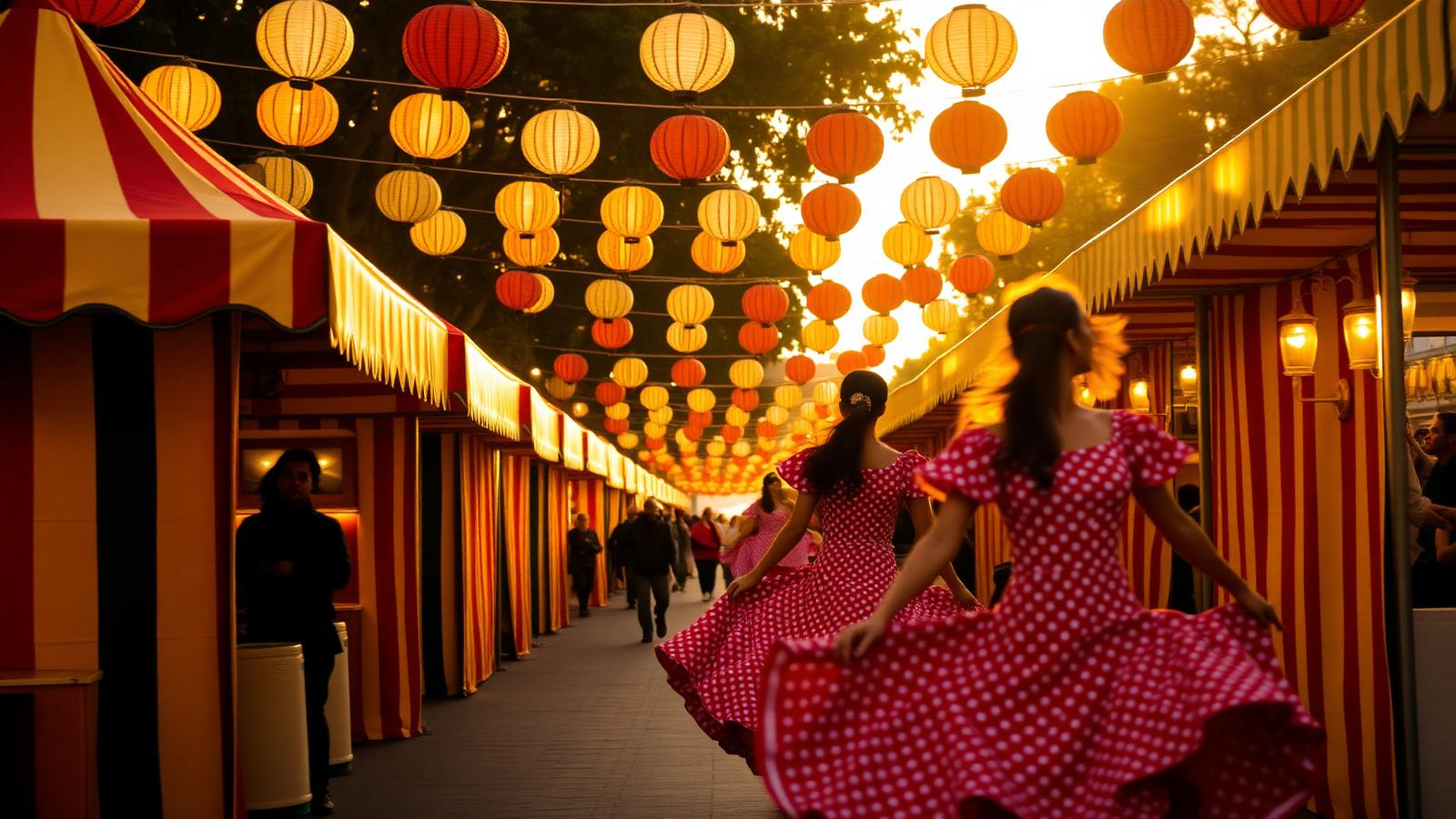
Daytime (afternoon, from about 1pm to 8pm): This is the most visually spectacular period. Sevillanas (the local dance form) and flamenco are performed in casetas. The main avenue fills with horses and carriages in a parade called the Paseo de Caballos. Women in traje de flamenca (the flamenco dress, a specifically Sevillano tradition not to be confused with performance costume) promenade through the streets. The colours — the polka-dotted dresses, the white horses, the bright awnings — are extraordinary in person.
Evening and night (from 9pm to dawn): The fair shifts character. The carriages and horses largely retire. The casetas become bars and dance floors. The energy builds through midnight and continues until approximately 6am for the young and the committed. Spanish fiesta culture takes late-night seriously, and Feria takes it to its furthest point.
Getting In and Getting Around
The fairground is free to enter. There is no ticket to walk through the Real de la Feria. What requires either an invitation or cash is entry to specific private casetas and the purchases you make once inside.
Transport: Getting to the fairground involves either a specific bus service (Tussam operates shuttle routes from central Sevilla, check current routes for the year you visit), walking across the Puente de Triana, or taxis. Taxis queue at the main entrance late at night — the queue can be long. Uber and Cabify operate in Sevilla and are often faster than traditional taxis during the fair — which means working data on a Spain eSIM is more useful than usual.
Cash: While cards are accepted in some casetas, cash is often preferred or required. ATMs near the fairground have long queues during fair week. Withdraw before you go.
Rebujito and the Food of Feria
Rebujito is the unofficial drink of the Feria de Abril. It's a simple mix of manzanilla sherry (a dry, saline style of sherry from the nearby town of Sanlúcar de Barrameda) and Sprite or 7-Up, served over ice in a glass. It's lighter and more refreshing than it sounds and is consumed in considerable quantities throughout the week.
Food within the casetas runs from simple tapas and montaditos to more elaborate sit-down meals depending on the caseta. Fried fish (pescaíto frito), jamón, and tortilla are Feria staples. Outside the fairground in central Sevilla, the city's restaurant culture continues normally, and the week is actually a pleasant time to eat out in the old city since some tourist pressure is redirected to the fairground. Pre-booking the Alcázar or Cathedral on a non-fair morning is a smart way to spend the calmer hours.
What to Wear
Women traditionally wear the traje de flamenca — a fitted, ruffled dress specific to this occasion. Wearing one as a visitor is entirely welcomed and is not considered appropriation; the Sevillanos genuinely appreciate visitors who dress for the occasion. Hiring (rather than buying) a traje de flamenca is common and rental shops are plentiful in the weeks before the fair. Men wear a suit, with or without a traditional corto (short-legged equestrian suit) if they're participating in the horse parade.
Coming in regular clothes is also fine. However, dressing up genuinely changes the experience — both how you feel within the fair and how warmly you're received.
The Honest Word on Visiting as an Outsider
Feria is a local celebration. Some visitors feel initially like observers rather than participants. The best response is to lean into the public elements — walk the streets, watch the dancing visible through caseta doors, attend the horse parade, eat and drink in the municipal casetas or the public area — and accept invitations if they come without trying to engineer access you haven't been given.
The fair rewards patience and presence. If you go expecting a performance put on for you, you'll be disappointed. If you go expecting to spend a day or two inside something genuinely Sevillano, you'll leave with one of the best travel memories of your life.
Good to know: Book accommodation in Sevilla months in advance for Feria week. Prices rise significantly and availability disappears early. The city is worth several days before and after the fair in its own right.
Keep exploring
If this story landed, you'll probably enjoy Thailand's festival calendar, the Notre Dame de Paris musical, Mallorca beyond the resorts next.
Sources & further reading
Frequently asked questions
- When is the Feria de Abril held?
- Usually two weeks after Easter Sunday, Monday to Sunday, with the lighting of the gate (alumbrado) on Saturday at midnight. Exact dates shift each year — check the official Sevilla tourism calendar.
- Do you need to wear flamenco dress to attend the Feria?
- No. Locals dress up — women in trajes de flamenca, men in suits or short jackets — but you don't have to. Smart casual works fine for daytime. Avoid shorts and flip-flops if you want to blend in.
- Can tourists enter the casetas?
- Most casetas at the Feria are private, run by families, businesses or associations. Public casetas (run by the city districts and political parties) welcome anyone — that's where most first-time visitors will eat, drink and dance Sevillanas.
Tools & links from this story
Some links are affiliate. They cost you nothing and keep this site running.
- Kiwi.com — flights to Sevilla (SVQ) →Direct routes from most European hubs in spring.
- Klook — Sevilla transfers and tours →Useful for Alcázar and Cathedral skip-the-line on non-fair days.
- Airalo — Spain eSIM →Cabify and Uber both run during the fair — data matters.
- EKTA — Schengen travel insurance →Covers the trip and meets entry requirements.
Written by
Meric Erdinc · Founder, 1-Minute Nomad
Meric has spent the last six years moving around Southeast Asia and beyond, with a laptop, a rotating set of Wi-Fi passwords, and an opinion on every co-working space he’s ever stepped into. Rooted in Istanbul, currently working out of Bangkok — though the next flight is usually already booked. He started 1-Minute Nomad for people like him: nomads who don’t have time to read forty Reddit threads to figure out a city. Every guide here comes from a place he’s actually lived, worked or months of on-the-ground research.
Subscribe
Get the next dispatch
One email when a new city guide drops. No spam, no daily noise.