Roam Therapy
How to Actually Connect With Locals When You Travel
Last updated · 8 min read
There's a version of "connecting with locals" that is, if we're honest, still tourism. You go to a highly-rated local restaurant, eat very well, nod approvingly at the food, and the next day describe the experience as having really understood the culture. The food was probably good. You didn't really understand the culture.
Genuine connection with people who live in the places you visit is harder and slower than most travel content admits. It also happens to be one of the things that makes travel genuinely transformative rather than just enjoyable.
Here's what actually works, and what doesn't.
Why most attempts at "local connection" fail
The structural problem is asymmetry. Tourists pass through; residents stay. For a local person, the calculus of investing in a conversation with a tourist is: spend time and energy, develop a potential friendship, watch that person leave in four days. Many people simply don't want to run that cycle repeatedly, and who could blame them.
This means the burden is on the traveler to create conditions where connection is worth something to the other person, not just an experience to collect for yourself.
The approaches that don't work: hanging out at tourist-facing bars and calling the English-speaking staff your friends, doing a walking tour and then describing the guide as a connection, or asking someone to recommend a restaurant and treating that transaction as cultural exchange.
The approaches that do work are slower, require more preparation, and feel different — more like building something than consuming something.
Language: even a little goes a long way
You don't need to be fluent. You need to be making an effort. Learning twenty words in a local language — greetings, please, thank you, basic numbers, "do you have...?" — signals something that translates across all cultural contexts: this person cares enough to try.
That signal matters because it reframes you from tourist to visitor. The difference is subtle but real. A tourist is passing through and wants to be served. A visitor has some respect for the place and the people in it.
Start with the basics two or three days before you arrive. Apps work fine for this level of preparation. You won't speak the language. You will be able to say good morning and thank you with something approaching correct pronunciation, and that will open more conversations than you expect.
The institutions that generate real interaction
Certain types of places structurally create the conditions for genuine exchange, in ways that restaurants and tourist attractions don't:
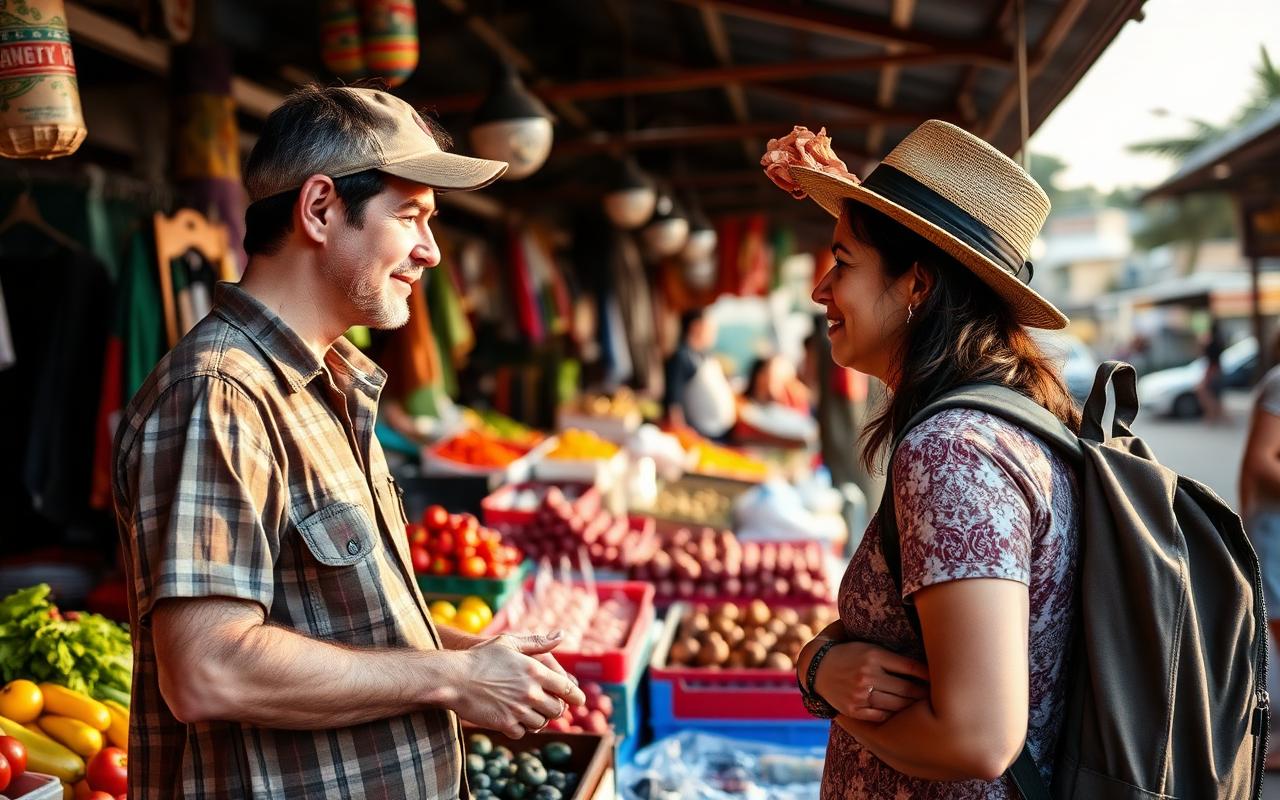
Markets. Not the tourist market selling crafts — the actual food market where people buy groceries. The interactions here are brief but real. You're there for the same reason everyone else is. The transactions are simple, the setting is non-transactional enough that conversations can happen organically.
Language exchanges. Many cities have organized language exchange meetups where locals who want to practice English meet travelers who want to learn the local language. These are explicitly mutual in their design — everyone's there to get something and give something. Look for them on Meetup.com or Couchsurfing's events section.
Cooking classes run by actual home cooks. This is a different experience from a commercial cooking school. Eatwith hosts experiences that often fall into this category — a local person's home, a small group, a meal cooked together and eaten together. The format creates conversation naturally because you're doing something side by side, which is how most real human connection happens. Not face-to-face with the pressure of explicit communication, but shoulder-to-shoulder, working toward something together.
Community sports. Running clubs, beach volleyball, yoga classes, whatever the local equivalent is. Physical activity creates an easy social context — you don't have to carry a conversation because the activity does it for you.
Neighborhood over city center
Tourist areas exist to serve tourists. The interactions you'll have there are calibrated to extract money from you as efficiently as possible while being pleasant about it. That's fine — it's a service, not a relationship.
If you want to meet people who live in the city, spend time in the neighborhoods where people live. Take the metro one or two stops past the point where tourists normally get off. Find the café without English on the menu. Eat at the place with plastic chairs and a handwritten board. You're now in territory where being a foreigner is mildly unusual rather than the entire premise of the operation.
This shifts the dynamic. People are mildly curious about why you're here. Brief conversations happen. You start to feel the actual texture of the place.
GetYourGuide and Klook both have a category of neighborhood-focused experiences and local guide tours that are different from the standard attraction tours — walks through residential areas with guides who are actually from there, food tours that go where locals eat rather than where tourists are directed. These can serve as a bridge into the neighborhood-level experience before you've developed your own instincts for where to go.
The reciprocity principle
The most reliable way to connect with people anywhere is to offer something before you ask for it. Not in a calculated or transactional way — just the baseline social orientation of being genuinely interested in someone else's life before redirecting the conversation to your own needs.
Ask about someone's work before asking for a restaurant recommendation. Listen to the answer. Ask a follow-up question. Be in the conversation as a person rather than as a tourist with a checklist.
This sounds simple because it is simple. It's also not how most people travel, because most people are tired and distracted and in a mild hurry. Slowing down enough to actually be present in an interaction is the whole game.
What you're actually looking for
The goal isn't to compile a roster of international contacts. It's to understand a place from the inside, even slightly — to have enough genuine exchange with people who live somewhere that you leave with a more complicated, more accurate picture than you arrived with.
One real conversation is worth more than twenty pleasant transactions. The city you leave understanding is more interesting, more yours in some sense, than the city you leave having photographed.
That's the point. Not connection as a travel achievement, but connection as the actual content of what travel can be.
Keep exploring
Pair this with the art of slow travel and the culture shock survival guide.
Tools & links from this story
Some links are affiliate. They cost you nothing and keep this site running.
- Klook — small-group local experiences →Food tours and neighborhood walks with local guides.
- Kiwi.com — fly into the right base →Compare neighborhood-friendly secondary airports.
- Airalo — stay reachable for new plans →Local eSIM activated before you land.
Written by
Meric Erdinc · Founder, 1-Minute Nomad
Meric has spent the last six years moving around Southeast Asia and beyond, with a laptop, a rotating set of Wi-Fi passwords, and an opinion on every co-working space he’s ever stepped into. Rooted in Istanbul, currently working out of Bangkok — though the next flight is usually already booked. He started 1-Minute Nomad for people like him: nomads who don’t have time to read forty Reddit threads to figure out a city. Every guide here comes from a place he’s actually lived, worked or months of on-the-ground research.
Subscribe
Get the next dispatch
One email when a new city guide drops. No spam, no daily noise.